If your water heater is under 7 years old and the repair costs less than half of replacement, repair is almost always the smarter financial decision. If it's over 12 years old, replacement is the right call regardless of the issue — the risk of sudden failure and water damage grows significantly every year past that mark. Charleston Plumbing Services provides an honest written comparison of both options before any decision is made throughout Charleston, WV.
Your water heater stopped working — or it's making sounds it has never made before, or there's water pooling somewhere it shouldn't be. Now you're facing the question that every homeowner eventually has to answer: is it worth fixing this, or is it time to replace it entirely? Get it wrong in one direction and you spend money repairing something that's going to fail again in six months. Get it wrong in the other direction and you replace a unit that had years of reliable service left in it.
The honest answer depends on three things — the age of your unit, the nature of the problem, and the cost of the repair relative to the value of the remaining useful life. This guide walks you through a clear, practical decision-making framework so you can have an informed conversation with your plumber and make the right call for your home and your budget. These are the same principles Charleston Plumbing Services applies when assessing every water heater in the Kanawha Valley — and our recommendation is always honest, never driven by which option generates more revenue for us.
The Age Rule — Where to Start Every Assessment
Age is the single most reliable starting point for the repair versus replace decision — not because older units automatically need to be replaced, but because age determines how much useful life remains after a repair and therefore how much that repair is actually worth paying for.
Repair is almost always the right call. A younger unit with a failed component — thermostat, heating element, anode rod — has significant useful life remaining. Investing in a repair makes financial sense in virtually every scenario except active tank corrosion or a leak from the tank body itself.
Evaluate carefully. Get a written repair estimate alongside a replacement cost before deciding. If the repair is minor and the unit has been well-maintained, repair may still make sense. If the repair is significant or the unit has never been serviced, replacement is worth considering seriously.
Lean toward replacement. A tank water heater approaching the end of its expected 8 to 12-year lifespan is investing repair money into a unit that may need full replacement within a few years anyway. Use the repair cost as part of the replacement budget decision rather than spending it to extend a unit's final years.
Replace — regardless of what's wrong. A water heater past its expected lifespan is operating on borrowed time. The risk of sudden catastrophic failure — and the water damage that results — grows significantly with every year past the 12-year mark. Repair money spent here is almost always money spent twice.
Look for the manufacturer's label on the side of the tank. The serial number typically encodes the manufacture date — the first four characters often represent the year and week of production (e.g., "2214" = 2022, week 14). If you can't decode the serial number, search the manufacturer's name and serial number format online. Charleston Plumbing Services can also identify the age during a service call.
When to Repair Your Water Heater
Many water heater problems are repairable — and for a younger unit, repair is almost always the most financially sensible option. The key is understanding which problems are worth fixing and which ones signal that the unit's end is closer than a repair would make it worth spending money on.
✓ Repair Makes Sense When...
- Unit is under 7 years old and in otherwise good condition
- Repair cost is less than 50 percent of replacement cost
- Failed thermostat — gas or electric
- Burned out heating element on electric unit
- Faulty or leaking pressure relief valve
- Depleted anode rod causing odor or accelerated corrosion
- Loose or leaking pipe connection at the tank
- Pilot light or igniter failure on gas unit
- Sediment buildup causing noise — flush may resolve
→ Replace Makes Sense When...
- Unit is over 12 years old regardless of the issue
- Repair cost exceeds 50 percent of replacement cost
- Tank body is actively leaking or visibly corroded
- Rust-colored water from hot taps indicating internal corrosion
- Multiple components failing in a short period
- Unit has never been serviced and is heavily scaled
- Energy bills have increased noticeably without usage change
- Hot water demand has outgrown the tank's capacity
- Planning to upgrade to tankless for energy savings
Warning Signs That Mean Call a Plumber Today
Some water heater symptoms indicate a problem that needs professional attention immediately — not next week, not when you get around to it, but today. These situations either involve active damage risk to your home or indicate a failure mode where the unit may let go completely without further warning.
Water Heater Warning Signs That Require Same-Day Service
- Water pooling around the base of the tank — indicates a tank body leak that will worsen rapidly and can flood the utility area
- Rust-colored or brown hot water from multiple fixtures — indicates active internal corrosion inside the tank
- Gas smell near the water heater — evacuate immediately and call from outside
- Pressure relief valve discharging water — indicates dangerous pressure buildup inside the tank
- No hot water combined with a gas smell anywhere in the home — potential gas supply issue requiring immediate attention
- Loud banging or rumbling sounds that have intensified suddenly — may indicate extreme sediment buildup or imminent element failure
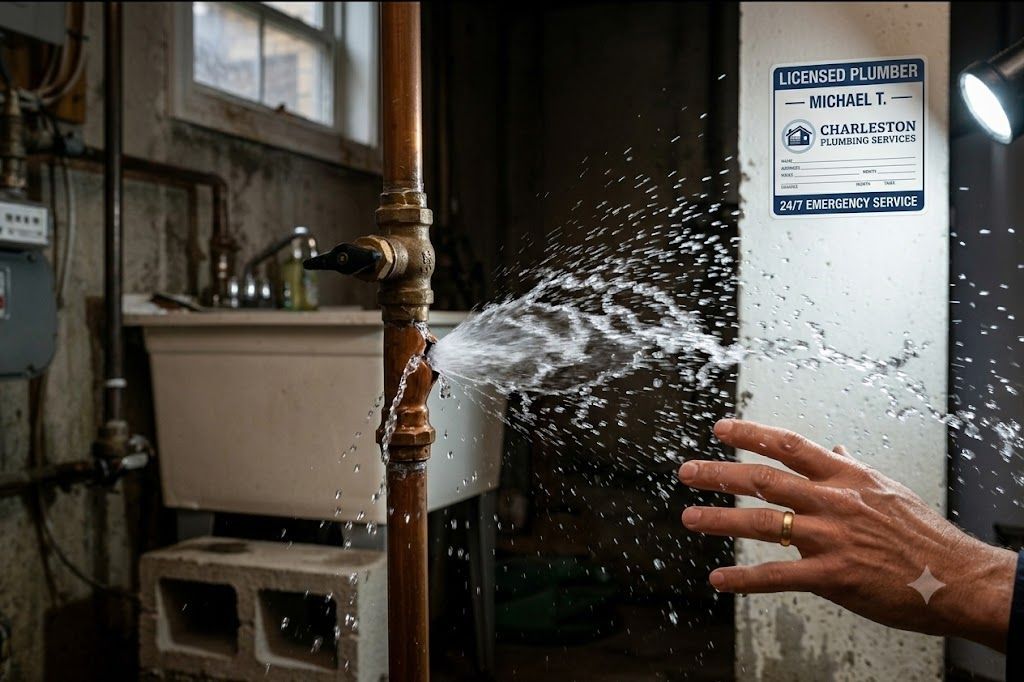
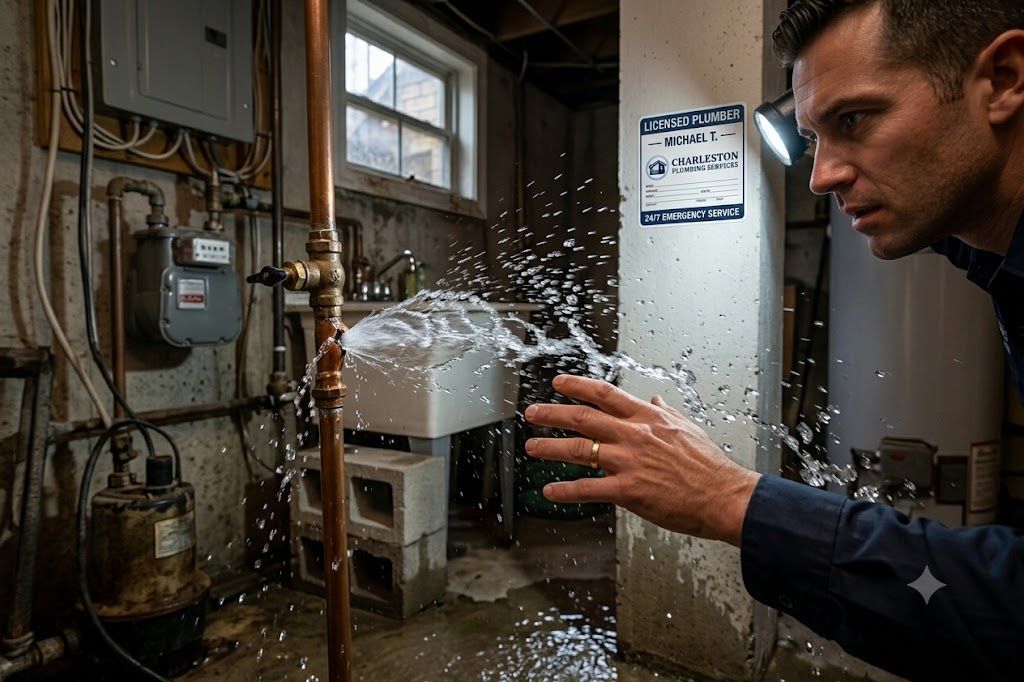
Water leaking from the tank body itself — the steel cylinder, not the connections or fittings — means the tank has corroded through internally and cannot be repaired. A leaking tank will fail completely, and when it does, it can release 40 to 50 gallons of water into your utility room or basement in a very short time. If you see water coming from the tank body, call Charleston Plumbing Services immediately — same-day replacement is available throughout the Kanawha Valley.
Repair vs Replace — The Cost Comparison
Understanding what repairs and replacements actually cost in the Charleston, WV market puts the financial decision in concrete terms. The general rule is simple: if the repair costs more than 50 percent of what a new unit would cost installed, replacement is almost always the better long-term investment — particularly for units approaching the end of their expected lifespan.
| Repair Type | Typical Cost in Charleston, WV |
|---|---|
| Thermostat replacement — electric unit | $100 – $200 |
| Heating element replacement | $150 – $250 |
| Pressure relief valve replacement | $100 – $175 |
| Anode rod replacement | $150 – $250 |
| Professional tank flush — sediment removal | $79 – $150 |
| Gas valve or igniter replacement | $175 – $350 |
| Pipe connection repair at tank | $99 – $200 |
| Replacement Type | Typical Installed Cost in Charleston, WV |
|---|---|
| Traditional tank water heater — 40 gallon | $800 – $1,300 |
| Traditional tank water heater — 50 gallon | $900 – $1,500 |
| Tankless water heater — gas | $1,200 – $2,000+ |
| Tankless water heater — electric | $800 – $1,500 |
All replacement costs above include removal and disposal of your old unit, full installation, connection to gas or electric supply, and a complete system test before we leave. Charleston Plumbing Services provides free written estimates for both repair and replacement options on every water heater call — so you have both numbers in front of you before making any decision.
Is a Tankless Water Heater Worth Considering?
If your existing tank water heater is old enough that replacement is the right call, the timing creates a natural opportunity to consider whether upgrading to a tankless system makes sense for your home. It's a worthwhile conversation to have while you're already investing in a replacement — the decision doesn't cost anything extra to evaluate, and the right answer genuinely depends on your specific home and usage patterns.
The Case for Going Tankless
Tankless water heaters eliminate standby heat loss — the energy consumed keeping a stored tank of water hot around the clock whether you're using it or not. For most households, this reduces water heating energy costs by 20 to 30 percent annually. A well-maintained tankless unit from a quality brand like Rinnai or Navien lasts 20 years or more, compared to 8 to 12 for a traditional tank. And for larger households with high simultaneous hot water demand throughout Teays Valley, Scott Depot, and Hurricane, WV, the unlimited on-demand hot water experience alone is often worth the upgrade investment.
When a Traditional Tank Replacement Makes More Sense
A standard tank replacement is the right call when your gas line doesn't have the capacity to support a tankless unit's higher BTU demand without a line upgrade — which adds cost. It's also the better fit for smaller households with moderate hot water demand, properties on well water with high mineral content that would require more frequent tankless maintenance, and situations where the replacement budget is tighter and the upfront cost difference is a meaningful constraint.
Charleston Plumbing Services gives you an honest assessment of both options — tank and tankless — with clear written pricing for each before any decision is made. We never recommend the more expensive option just because it generates more revenue.
What Happens During a Water Heater Assessment
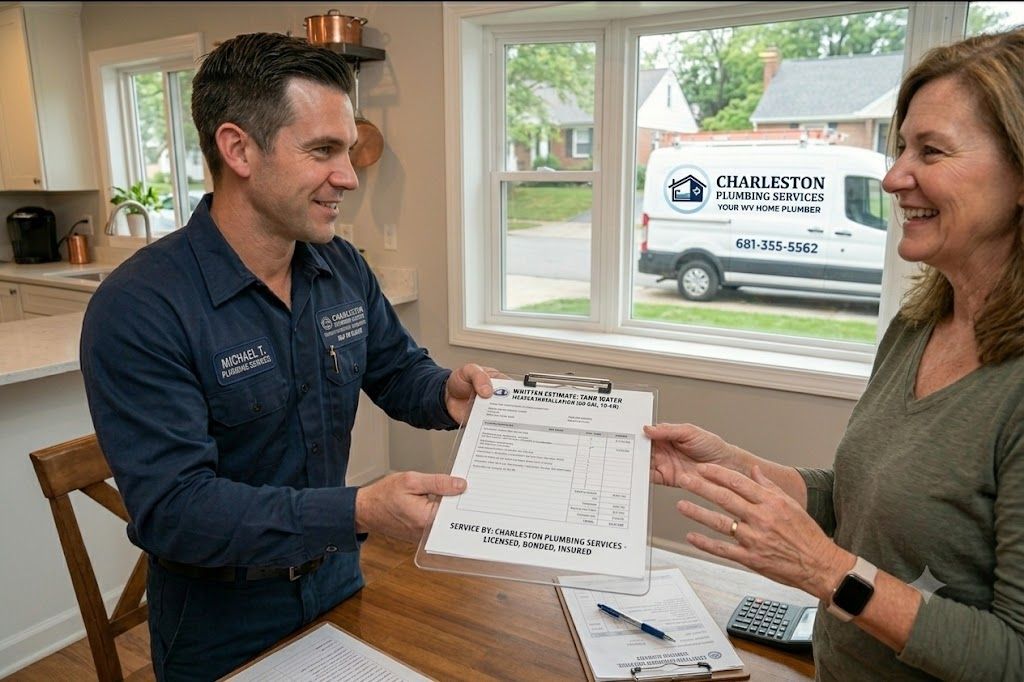
When you call Charleston Plumbing Services for a water heater that isn't performing correctly, our process is straightforward and transparent. We arrive, assess the unit completely — checking the age, inspecting the tank body for corrosion, testing the thermostat and heating elements, checking the anode rod condition, assessing the pressure relief valve, and reviewing the overall installation. We then give you a clear, written summary of what we found and what the options are.
If repair makes sense, we give you the repair cost in writing before touching anything. If replacement is the better recommendation, we give you written pricing for a tank replacement and, if relevant, a tankless upgrade option alongside it. You decide. We never pressure a replacement when a repair is the honest recommendation, and we never recommend a repair when replacement is clearly the more financially sound path. Our goal is to make sure you have the information you need to make the right call for your home and your budget — and then to do the work expertly, on time, and at the price we quoted.
Ready to Get a Water Heater Assessment in Charleston, WV?
If your water heater is showing any warning signs — inconsistent temperatures, strange sounds, discolored water, visible moisture — don't wait for a complete failure. Call Charleston Plumbing Services today for a free water heater assessment throughout Charleston, South Charleston, St. Albans, Dunbar, Nitro, Hurricane, Teays Valley, Scott Depot, Cross Lanes, Sissonville, Belle, Elkview, and Fayetteville, WV. Same-day water heater installation is often available. Free written estimates on every call. Flat-rate pricing that doesn't change once work begins.
Get a Free Water Heater Assessment in Charleston, WV
Honest repair vs replace guidance, written estimates for both options, and same-day installation often available throughout the Kanawha Valley.