For most homes in Charleston, WV, professional drain cleaning every one to two years prevents buildup from causing blockages. Older homes with cast iron pipes — common throughout Charleston's historic neighborhoods, St. Albans, and Dunbar — benefit from annual cleaning. Large households of five or more people should also clean annually. If you've had a backup in the past 12 months, schedule a cleaning now rather than waiting for the next one.
Most homeowners don't think about their drains until something goes wrong — and by then, a simple preventive cleaning has turned into an emergency service call. A backed-up kitchen drain on the morning of a family gathering, a sewage backup that floods a bathroom floor, a main line blockage that affects every drain in the house simultaneously — these are the consequences of ignoring drain maintenance until the system forces the issue.
The good news is that drain problems are among the most preventable plumbing issues a homeowner faces. Professional drain cleaning on the right schedule removes the buildup, root intrusions, and debris that cause blockages before they reach the point of failure. This guide gives you honest, practical guidance on how often your drains should be professionally cleaned based on your home's specific situation — and what the warning signs look like when your drains are telling you they need attention right now, not next year.
The Right Drain Cleaning Schedule for Every Home Type
There is no single answer to how often drains should be professionally cleaned — the right schedule depends on several factors specific to your home. The age of your plumbing system, the number of people in your household, the type of pipe material in your drain lines, and whether you've had previous drain problems all affect how frequently professional cleaning is the right call. Here is a practical breakdown by home type.
Standard Residential Home
Every 1-2 Years2-4 person household, modern PVC drain pipes, no history of recurring backups. Annual or biennial cleaning prevents gradual buildup from reaching blockage levels.
Older Home — Pre-1980
Every YearCast iron or clay drain pipes common throughout Charleston's historic neighborhoods develop rough interiors over time that accumulate debris significantly faster than modern PVC.
Large Household — 5+ People
Every YearHigher daily drain load accelerates buildup in kitchen and bathroom lines. Annual cleaning keeps systems ahead of the accumulation curve regardless of pipe material or age.
Previous Backup in Past Year
Now — Don't WaitA drain that has backed up once is significantly more likely to back up again. Schedule professional cleaning immediately rather than waiting for the annual cycle to come around.
Mature Trees on Property
Every YearProperties throughout the Kanawha Valley with mature trees are at elevated risk for root intrusion in sewer lines. Annual camera inspection and cleaning catches root growth before it causes structural damage.
Commercial Properties
Every 1-3 MonthsRestaurants and food service facilities need grease trap cleaning every 1-3 months. Commercial drain lines serving high-volume kitchens benefit from monthly or quarterly professional cleaning.
Why Charleston, WV Homes Need More Frequent Drain Cleaning
The Kanawha Valley's housing stock and geography create specific conditions that make drain maintenance more important here than in many other markets. Understanding these local factors helps you make a more informed decision about your own cleaning schedule.
Aging Cast Iron and Clay Drain Systems
A significant portion of homes throughout Charleston's historic neighborhoods, St. Albans, Dunbar, and South Charleston were built between the 1930s and 1970s with cast iron drain pipes that are now 50 to 90 years old. Cast iron doesn't fail all at once — it deteriorates gradually over decades, developing rough, pitted interior surfaces that catch and hold grease, soap scum, hair, and debris at a dramatically accelerated rate compared to modern smooth-walled PVC pipe.
A new PVC drain line running clean for two years might have a thin coating of residue that annual cleaning handles easily. A 60-year-old cast iron line running for the same two years without cleaning may have accumulated enough buildup to meaningfully restrict flow — particularly in horizontal runs where gravity drainage is already working at its minimum. If your home has cast iron drain pipes and you haven't had them professionally cleaned in the past year, that cleaning is overdue.
Mature Tree Canopy Throughout the Valley
The Kanawha Valley's established neighborhoods are characterized by mature trees — oaks, maples, and other large hardwoods that have had decades to extend their root systems throughout residential lots. These roots are drawn to the moisture and nutrients present in sewer lines, and they infiltrate even small cracks in aging clay or cast iron pipe joints with remarkable determination.
Root intrusion doesn't announce itself until it's already causing significant flow restriction or structural damage. The roots grow slowly, getting thicker and more branched with each season, until what started as a hairline infiltration becomes a blockage that professional snaking can clear only temporarily before the roots grow back. Annual camera inspection and cleaning of sewer lines on properties with large trees is not optional maintenance in many Kanawha Valley neighborhoods — it's the difference between a manageable cleaning bill and a full sewer line replacement.
Charleston Plumbing Services finds tree root intrusion in residential sewer lines throughout older Kanawha Valley neighborhoods on a daily basis — in communities like Dunbar, St. Albans, South Charleston, and Nitro where mature trees and aging clay or cast iron sewer lines coexist. Annual inspection and hydro-jetting keeps root growth manageable and protects the structural integrity of the pipe.
Warning Signs Your Drains Need Professional Cleaning Right Now
Regardless of when your last professional cleaning was, certain warning signs indicate your drains need attention immediately — not at the next scheduled interval. If any of the following are present in your home, call a plumber before the situation progresses to a full backup or sewer line failure.
Signs You Need Drain Cleaning Now — Not Later
- Multiple drains throughout your home are running slowly at the same time — indicates a main line restriction, not just a localized clog
- Gurgling or bubbling sounds from your toilet when you run water elsewhere in the house
- Foul sewage odors coming from drains inside your home, particularly in the basement
- Water backing up into a tub or floor drain when you flush the toilet or run the washing machine
- A drain that has backed up in the past 12 months — even once
- Unusually slow draining throughout the entire house rather than just one fixture
- Wet or unusually green patches in your yard over the path of your sewer line
A single slow drain is almost always a localized clog. Multiple slow drains throughout your home simultaneously are a warning sign of a developing main sewer line blockage. Homeowners frequently treat each slow drain individually for months before a full backup reveals that all of them were symptoms of the same underlying problem. If more than one drain in your home is running slowly, call for a professional assessment before it escalates to a sewage backup.
Professional Drain Cleaning vs Store-Bought Drain Cleaner
Before covering what professional drain cleaning actually involves, it's worth addressing the most common alternative — the bottle of chemical drain cleaner under the sink. Products like Drano and Liquid-Plumr are marketed as convenient solutions, and they do work in the very short term for minor organic clogs near the drain opening. The problem is what they do to your pipes over time.
Chemical drain cleaners work by generating heat through a caustic chemical reaction that dissolves organic material. That reaction doesn't distinguish between the clog and the pipe itself. Repeated use of chemical cleaners degrades PVC fittings, accelerates corrosion in aging metal pipes, softens the adhesive joints in plastic pipe systems, and in cast iron pipes already weakened by age, can accelerate the internal deterioration that causes them to fail. The temporary clearing of a clog comes at a cost that compounds with every application.
More importantly, chemical cleaners address the symptom — the blockage — without touching the cause. Grease coating the walls of your kitchen drain line, mineral scale narrowing the interior of your supply pipes, root fibers infiltrating your sewer line — none of these respond to a bottle of chemical cleaner poured down the drain. The clog clears temporarily, the underlying cause remains, and the next blockage forms faster because the pipe walls are now rough from chemical exposure.
Professional drain cleaning in Charleston, WV uses mechanical augers to physically remove blockages and hydro-jetting to scour the interior pipe wall completely clean — removing not just the blockage but the buildup on the walls that caused it. The result lasts significantly longer because the underlying cause is actually addressed rather than masked.
What Professional Drain Cleaning Actually Involves
Understanding what a professional drain cleaning visit covers helps you set accurate expectations and evaluate whether the service you're getting is thorough enough to justify the cost.
Mechanical Auger Cleaning
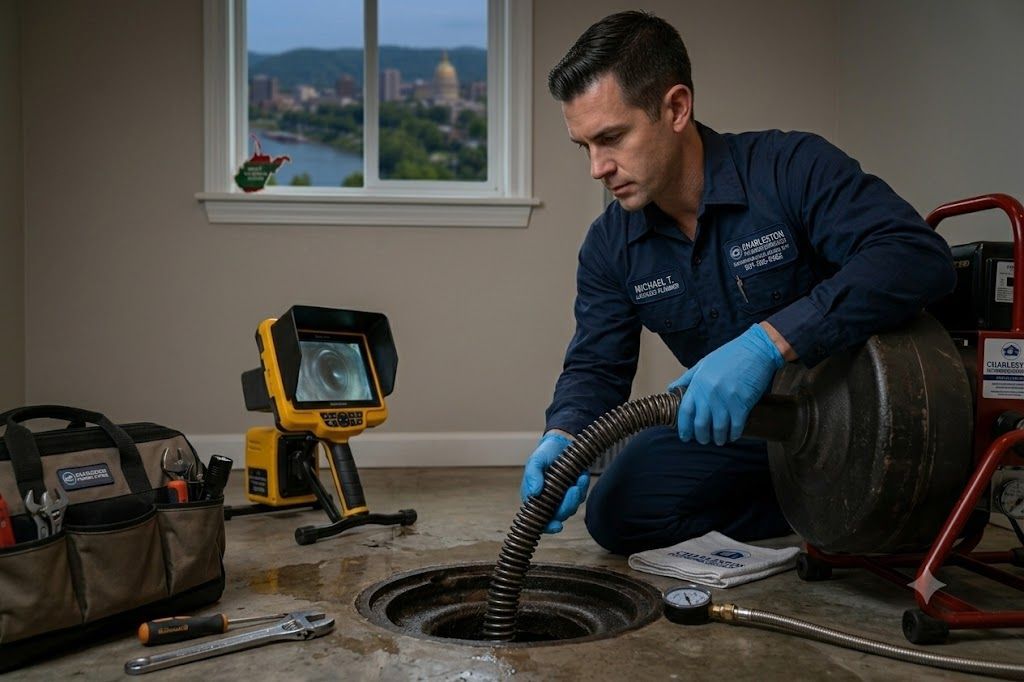
A mechanical drain snake — also called an auger — is a flexible cable fed through your drain line to physically break up and pull out blockages. For a localized clog in a sink, tub, or toilet drain, mechanical snaking is typically fast and effective. For main sewer line blockages, heavier-duty mechanical augers are used that can clear blockages up to a certain severity. Mechanical cleaning punches through the blockage and creates a clear path — but it does not clean the pipe walls.
Hydro-Jetting
Hydro-jetting uses a high-pressure water stream delivered through a specialized nozzle that sprays in multiple directions simultaneously to scour the entire interior pipe wall clean as it moves through the line. It removes grease coatings, mineral scale, soap scum, accumulated debris, and smaller root intrusions completely — restoring the pipe close to its original interior diameter. Hydro-jetting is the most thorough drain cleaning method available and delivers results that last significantly longer than mechanical cleaning alone. It is particularly recommended for older homes, commercial kitchens, and any property with a history of recurring drain problems throughout the Kanawha Valley.
Video Camera Inspection
For sewer lines and main drain lines, video camera inspection provides a real-time high-definition view inside the pipe to identify the exact cause and location of any problem before deciding on the right cleaning or repair method. A camera inspection takes the guesswork out of recurring drain issues entirely — instead of clearing the same blockage repeatedly, we identify whether the cause is buildup, root intrusion, pipe deterioration, or a structural problem that requires repair rather than cleaning.
What Professional Drain Cleaning Costs in Charleston, WV
| Service | Typical Cost Range |
|---|---|
| Single drain cleaning — sink, tub, or toilet | $99 – $150 |
| Main sewer line cleaning — mechanical auger | $150 – $350 |
| Hydro-jetting — full sewer line service | $300 – $500 |
| Video camera sewer inspection | $199 – $299 |
| Root removal from drain or sewer line | $249 – $450 |
| Commercial kitchen drain cleaning | Call for estimate |
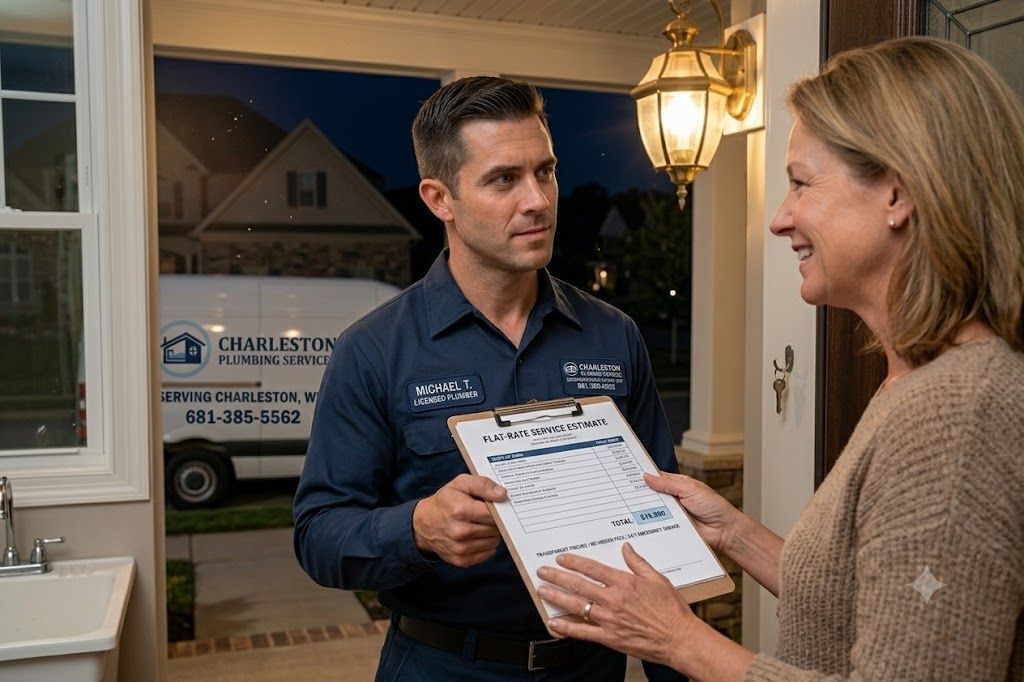
All pricing above reflects typical ranges for professional drain cleaning in the Charleston, WV area. Charleston Plumbing Services uses flat-rate pricing on every job — the written estimate provided before work begins is the price on your final invoice, with no surprise charges or hidden fees added after the fact.
Simple Habits That Extend Time Between Professional Cleanings
Professional drain cleaning on the right schedule is the foundation of good drain maintenance — but daily habits in your home affect how quickly buildup returns between cleanings. A few simple practices extend the time between professional visits and reduce the likelihood of an emergency backup between scheduled cleanings.
In the kitchen, never pour grease, cooking oil, or fat down the drain. These substances are liquid when hot but solidify inside the pipe as they cool, coating the walls and accumulating layer by layer with every application. Collect used cooking grease in a container and dispose of it in the trash once it has solidified. Run hot water for 30 seconds after washing dishes to help move any residual grease further down the line — though this is a complement to proper disposal, not a substitute for it.
In bathrooms, use a hair catcher on every tub and shower drain and clean it after every use. Hair is the primary cause of bathroom drain clogs, and preventing it from entering the drain is dramatically more effective than trying to clear it after accumulation. Avoid flushing anything other than toilet paper — wipes marketed as flushable are one of the leading causes of sewer line blockages throughout the Kanawha Valley and should always go in the trash.
The cost of professional drain cleaning every one to two years is a fraction of the cost of a single emergency sewer backup or main line replacement. Preventive maintenance is the most cost-effective plumbing investment a Kanawha Valley homeowner can make.
Ready to Schedule Your Drain Cleaning in Charleston, WV?
Whether you're due for a routine cleaning, dealing with a drain that's been running slowly, or managing a recurring backup problem that never seems to fully resolve, Charleston Plumbing Services is ready to help. We provide professional drain cleaning, hydro-jetting, video camera sewer inspections, and complete sewer line services for residential and commercial properties throughout Charleston, South Charleston, St. Albans, Dunbar, Nitro, Hurricane, Teays Valley, Cross Lanes, Sissonville, Belle, Elkview, and Fayetteville, WV.
Free written estimates on every job. Flat-rate pricing that doesn't change once work begins. Licensed, background-checked plumbers who treat your home with genuine respect. And real 24/7 availability for drain emergencies that can't wait until morning.
Schedule Professional Drain Cleaning in Charleston, WV
Call us today or request your free estimate online. Same-day drain cleaning often available throughout the Kanawha Valley.