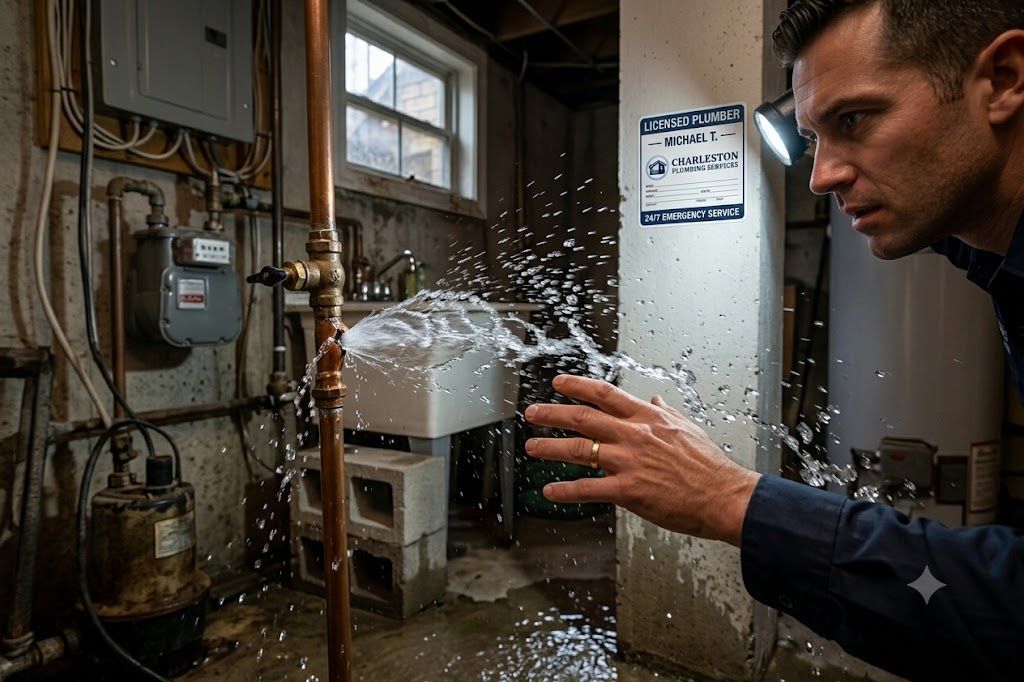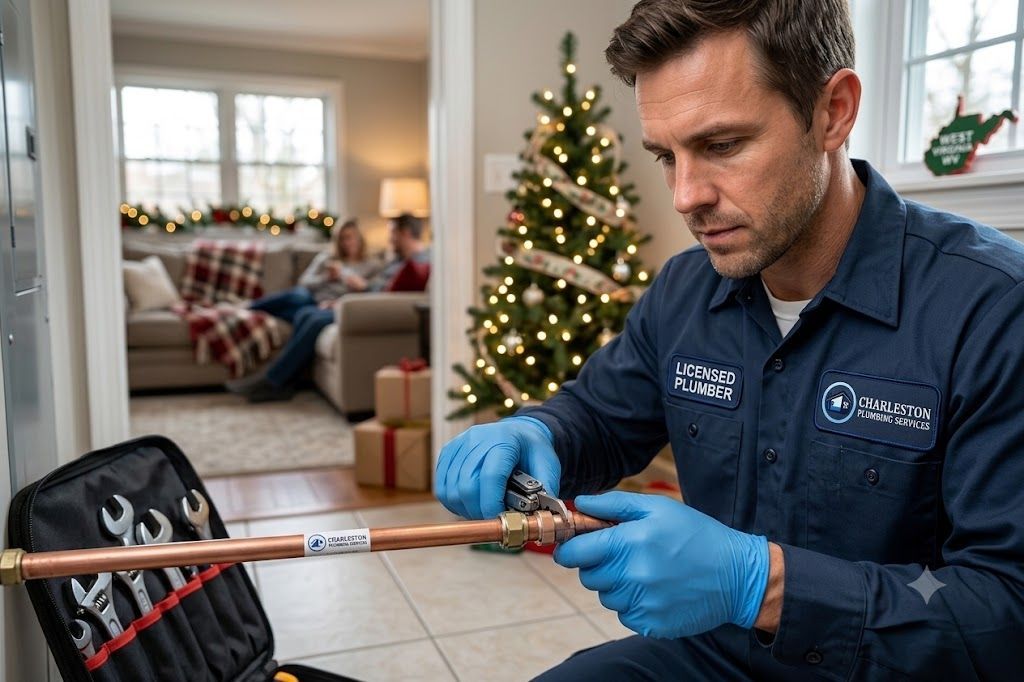
Shut off your main water supply valve immediately — it's typically in the basement, a utility closet, or near your outdoor meter. Turn it clockwise until it stops. Then turn off your water heater, open all faucets to drain remaining water, photograph all damage for insurance, and call Charleston Plumbing Services. We respond to burst pipes 24/7 throughout Charleston, WV and the Kanawha Valley, arriving prepared to make a complete repair on the first visit.
- Shut off the main water supply valve — basement, utility closet, or near outdoor meter. Turn clockwise until it stops completely.
- Turn off your water heater — gas or electric, shut it off immediately after the main valve is closed.
- Open all faucets — drain remaining water from supply lines to relieve pressure and minimize continued flow.
- Turn off electricity if water is near outlets or panel — call your electric company if you're unsure whether it's safe.
- Photograph all damage — document everything before cleanup for your insurance claim.
- Call Charleston Plumbing Services — 681-385-5562. We answer 24/7 and dispatch immediately.
A burst pipe is one of the most disorienting plumbing emergencies a homeowner can face — the combination of active water flow, the sound of something clearly wrong, and the immediate pressure to do something useful can make even calm people feel overwhelmed and uncertain about what to do first. The good news is that the correct sequence of actions is simple, takes less than five minutes to complete, and makes an enormous difference in how much damage actually occurs before the plumber arrives.
This guide walks you through every step of a burst pipe emergency in a Charleston, WV home — from the moment you discover the problem to the moment the repair is complete. We cover what to do first, what to do while you're waiting, what not to do, how to document the damage for your insurance company, and what to expect from the repair process itself. These are the same steps we walk homeowners through on every emergency call we receive throughout the Kanawha Valley.
Step 1 — Shut Off the Main Water Supply Valve Immediately
This is the single most important action you can take in the first moments of a burst pipe emergency — and it is the action that most directly determines how much damage occurs. Every second of water flow from a burst pipe adds to the volume of water spreading through your home. A residential supply line can release several gallons per minute. Ten minutes of delay means tens of gallons of water soaking into your floors, walls, and ceilings. Shutting off the main valve stops all of that instantly.
Where to Find Your Main Water Shutoff Valve
The main water shutoff valve controls water supply to your entire home. In most Charleston, WV area homes, it is located in one of three places — in the basement near where the main water line enters the foundation wall, in a utility closet or mechanical room on the main level, or in a small underground box near your outdoor water meter at the street. The valve itself is typically a round wheel valve that you turn clockwise to close, or a lever-style ball valve that you turn 90 degrees perpendicular to the pipe to close.
If you don't know exactly where your main shutoff valve is, find it now — before an emergency makes the search stressful and time-sensitive. Walk your basement or utility area, look near where the main supply line enters the building, and confirm the valve turns freely. A valve that is stuck or corroded won't help you during a burst pipe emergency. Call Charleston Plumbing Services to service a stuck shutoff valve before you need it — it's a straightforward repair that could save you thousands in damage later.
Individual Fixture Shutoff Valves
If the burst pipe is at or near a specific fixture — a toilet supply line, a kitchen faucet connection, or the supply lines under a bathroom sink — you may be able to shut off water to just that fixture rather than the entire house. Individual shutoff valves are located behind toilets (the oval knob low on the wall) and under sinks (the oval valves on the supply lines running to the faucet). These valves turn clockwise to close. If the burst is isolated to one fixture and the individual valve is accessible and functional, use it — it lets you maintain water service to the rest of the house while waiting for the repair.
Step 2 — Turn Off Your Water Heater
Once the main water supply valve is shut off, the next immediate step is turning off your water heater. This is a step that many homeowners skip in the urgency of the moment — and it can result in damage to the water heater on top of the burst pipe problem. Here is why it matters.
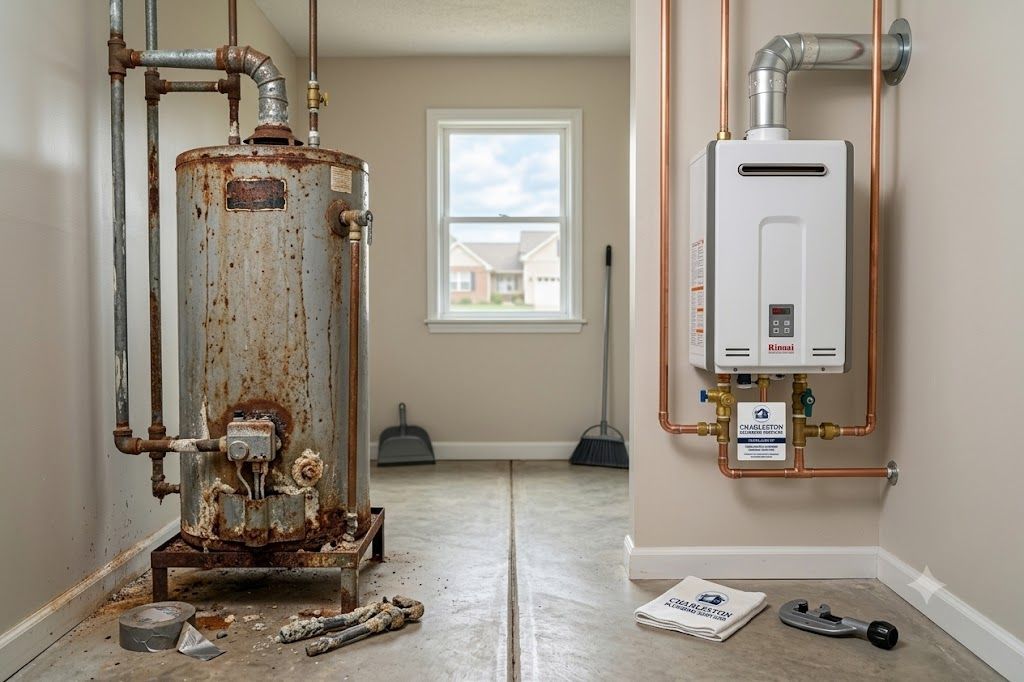
Water heaters — both tank and tankless — are designed to operate with a supply of water flowing through them. When the main valve is shut off, the water supply to the heater stops. If a gas water heater continues operating without water flow, the burner continues heating an empty or near-empty tank, which can damage or warp internal components. Electric water heaters face the same risk — the heating elements run dry and can burn out or fail. Shutting off the water heater immediately after the main valve protects the unit from this secondary damage and saves you from replacing a water heater on top of paying for a burst pipe repair.
For a gas water heater, turn the thermostat dial to the "Pilot" position. For an electric water heater, turn off the dedicated circuit breaker for the unit in your electrical panel.
Step 3 — Open Faucets Throughout the House
After shutting off both the main valve and the water heater, open every faucet